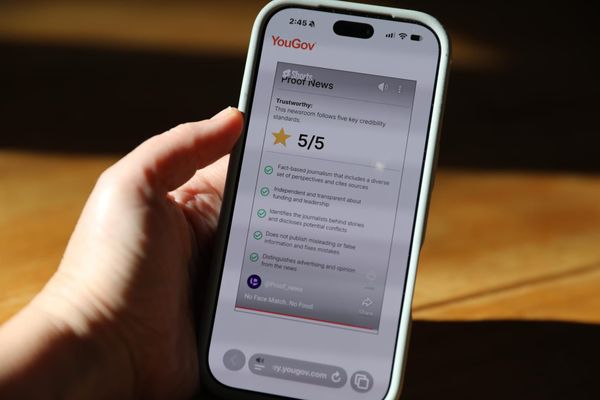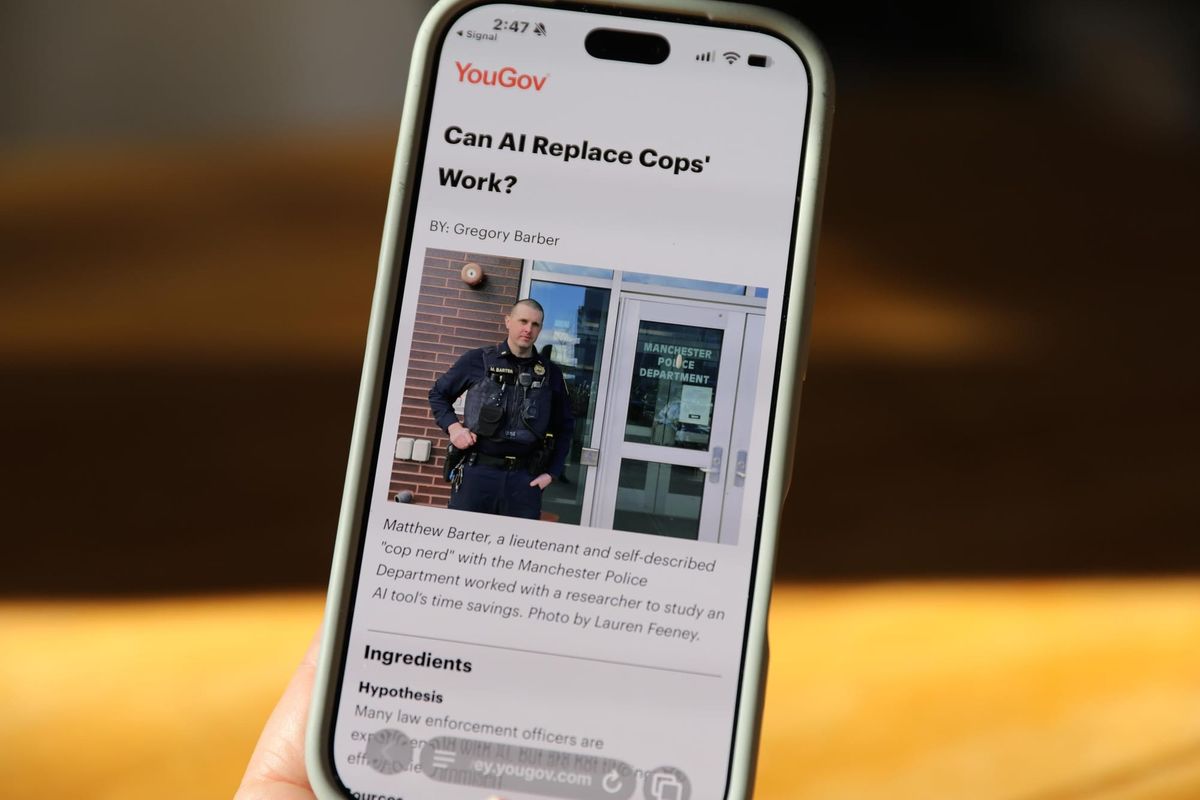
A Proof News study with research design and analysis by Sciences Po’s Damien Bol, Kevin Arceneaux, and Floriane Labarussiat.
Summary
About one in five US adults regularly get their news from news creators on social media, but audiences are sifting through an avalanche of misinformation, hot takes, and polarizing content. In the vast, diverse space of social media content, it can be difficult to understand whom to trust.
In response to this phenomenon, organizations including Proof News and the Trust Project have been experimenting with transparency labels that disclose reporting methods or a newsroom’s commitment to ethical principles. Some independent news creators have also begun posting about sources, AI use, and funding. It’s unclear, however, what impact those transparency efforts have on audiences.
To test the effect of labeling news content, US-based journalists at the tech accountability newsroom Proof News and political scientists at Sciences Po in France jointly surveyed US adults to gauge whether adding these labels to video and text stories significantly improved their trust in the story. The video survey asked a representative panel of 2,000 Americans for their perceptions of news credibility, trust in journalists, transparency and likelihood to share a story.
We found that spelling out the sources — where facts came from — substantially lifted viewer confidence in general news on short YouTube stories.
To test text articles, we showed another set of stories to a panel of 1,600 US adults. Here, too, we found the labels sometimes boosted trust metrics: A label describing the reporting process increased readers’ perception of transparency when used on a print story on a polarizing topic and on an investigative news story.
Prior Work
The research builds upon other experiments with trust labels across science, social media, and news.
In a 2022 publication, researchers in Germany tested badges certifying Open Data, Open Materials, and Open Code, finding signs of increased trust among readers of scientific papers. In a 2023 publication, South China Normal University researchers also looked at similar badges, finding they affected social media attention.
Some of these efforts are reshaping publishing. The Public Knowledge Project repurposed the widely recognizable Nutrition Facts label. The Publication Facts Label, which notes peer review, data availability, funding, publisher, and other facts, rolled out to journals using the project’s publishing software in 2024. By March 2026, it had been piloted in 130 journals.
The influence of political content remains a top concern. Researchers in the Netherlands and the US tested whether “traffic light” labels (red, orange, and green) effectively communicated the trustworthiness of political advertisements on YouTube. Their findings, published in 2023, showed a significant effect on credibility perceptions, but timing and position mattered.
Multiple researchers have looked at fact-checking labels. In research published in 2024, researchers showed about 1,800 Americans crowdsourced fact-checking, finding higher perceptions of trustworthiness with “community notes” explaining why the fact-checked post was misleading compared to simple misinformation flags. Another study published in 2024 also gauged crowdsourcing techniques and found third-party fact-checking labels more effective than algorithmic or other user labels. It also found a label for news media that boosted reader confidence, but less so than a third-party fact check.
The Labels
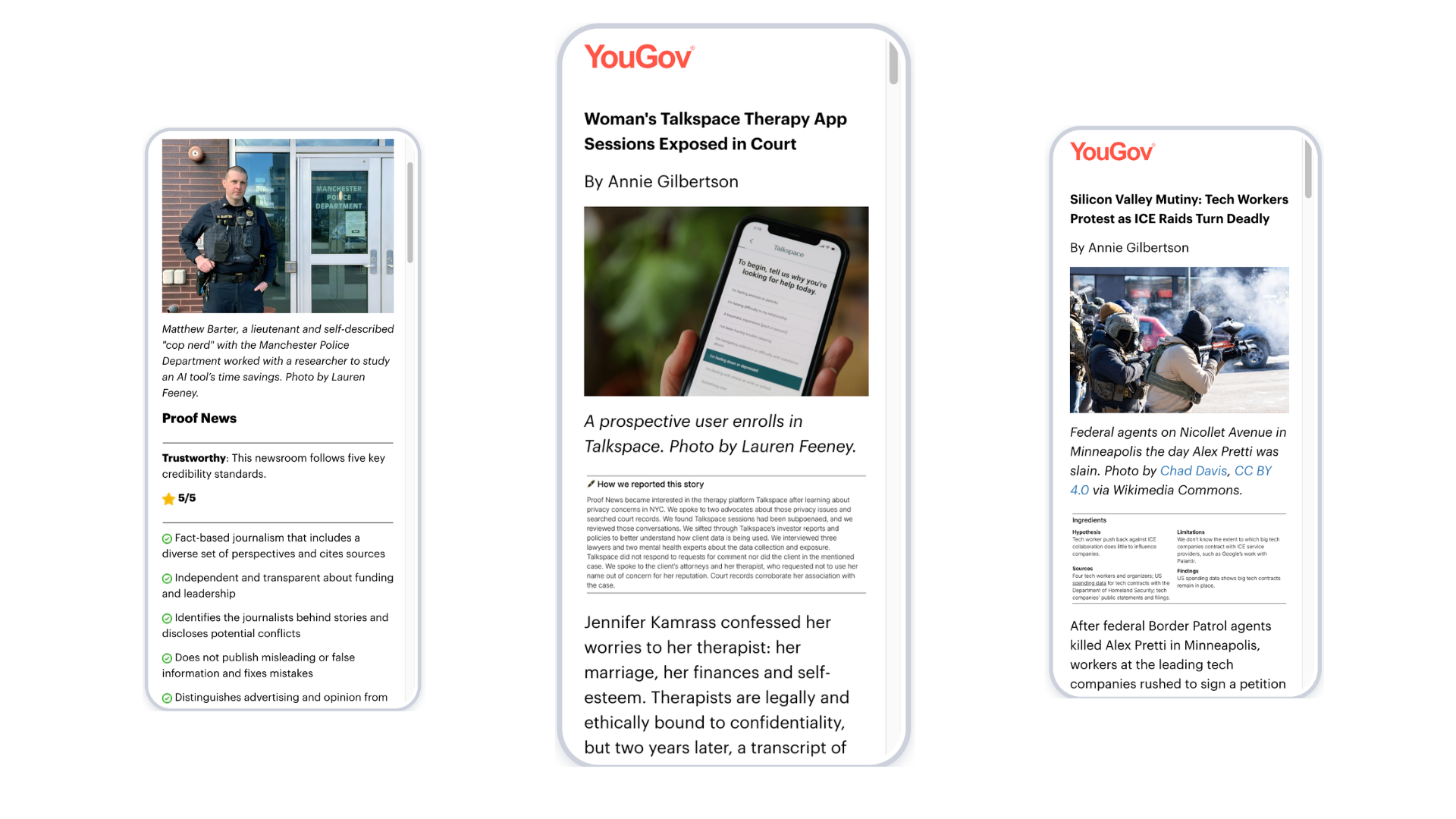
Proof News journalists developed three labels to test in print stories against how a story performed with no label at all:
- Ingredients Label: Proof’s Ingredients Label, which was modeled on the scientific method and included a hypothesis, sources, limitations, and findings of the story.
- Reporting Methods: A reporting methodology label, designed in partnership with the Trust Project, described the methods of reporting the story.
- Standards: A newsroom standards label, which was inspired by journalist and creator Dave Jorgenson’s ethics and transparency statement and outlined a newsroom’s adherence to best practices such as disclosing funders, distinguishing advertising from editorial content, and verifying facts.
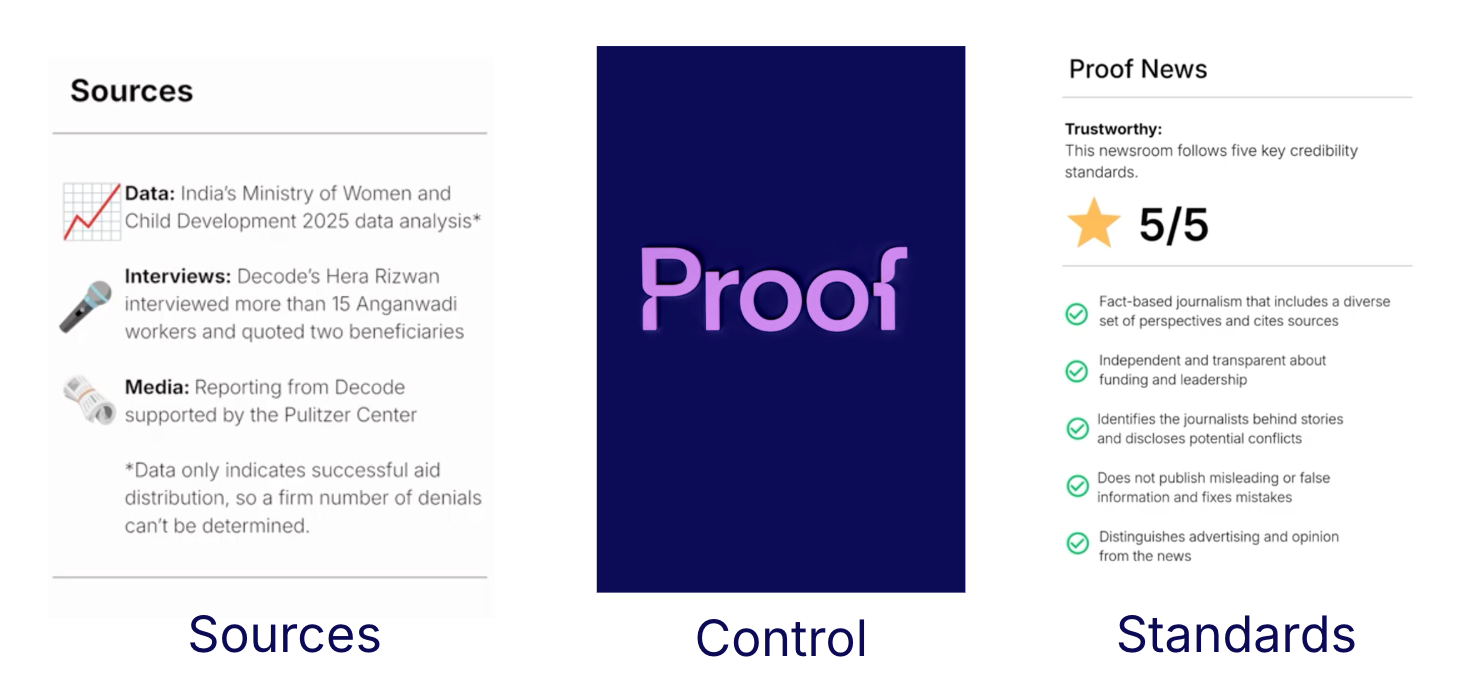
For video stories, the survey took a slightly different approach, testing not just different labels but also the placement of the label:
- Standards: The newsroom standards label remained the same.
- Sources (description): A slimmed-down version of the Ingredients Label included a source list and a single limitation to make it more skimmable for video.
- Sources (end): Some respondents saw the Sources or Standards labels at the end of the video, like a credits reel, while others were served the source list in the video description, the text that appears under YouTube videos.
The Stories
The team sought to determine whether labels had different effects on trustworthiness based on the type of news: general news, investigative news, and news on a polarizing topic. The journalists wrote new stories and did not release them publicly until after the surveys concluded to avoid prior-exposure bias.
All stories were written for Proof News, which focuses on AI and tech accountability. After the survey, all but one of the stories were published on its site. The unpublished story was too dated.
- General News: “Can AI Replace Cops’ Work?”
- Investigative: “Woman’s Talkspace Therapy App Sessions Exposed in Court”
- Polarizing: “Silicon Valley Mutiny: Tech Workers Protest as ICE Raids Turn Deadly”
Video
- General News: “No Face Match. No Food.”
- Investigative: “The Roboguard Revolution is Short-Circuiting”
- Polarizing: “Trump’s Family Positioned to Profit from AI-Powered Drones”
Respondents
The team collected demographic information about our respondents to better understand whether labels performed differently among various groups. Our survey provider, YouGov, routinely collects information about survey participants' gender, race, age, political leaning, state of residence, and level of education.
Additionally, we asked participants:
- How much do you trust scientists to act in the public interest?
- 0. Not at all
- 10. A great deal
- 99. Don’t know
- How interested are you in politics?
- 0. Not at all interested
- 10. Very interested
- 99. Don’t know
Trust Questions
YouGov programmed the surveys so that each respondent had to watch the full video or stay on the print page long enough to read the full article. Participants were then asked:
- On a scale from 0 to 10, to what extent do you find this news story credible?
- 0. Not at all credible
- 10. Extremely credible
- 99. Don’t know
- On a scale from 0 to 10, to what extent do you trust the journalist who produced this story?
- 0. No trust at all
- 10. Complete trust
- 99. Don’t know
- On a scale from 0 to 10, to what extent do you trust the media outlet that reported this story?
- 0. No trust at all
- 10. Complete trust
- 99. Don’t know
- On a scale from 0 to 10, to what extent do you agree with the following:
- A. The news story conveys depth of knowledge about the subject matter.
- B. The news story represents people fairly.
- C. The news story is transparent about how the news is made.
- D. The news story is polarizing, meaning it triggers both strong positive and strong negative reactions among the public.
- E. The news story is investigative, meaning it involved a high level of journalistic scrutiny.
- 0. Fully disagree
- 10. Fully agree
- 99. Don’t know
- How much would you like to share this news story with others?
- 0. Not at all
- 10. Very much
- 99. Don’t know
Analysis
Sciences Po political scientists used an OLS regression to model differences in survey responses (trust in journalists, perceived credibility, etc.) by treatment status. They first measured whether any form of labeling increased trust in the news story, the journalist, and the media outlet, as well as the perceived fairness, transparency, depth of knowledge, and willingness to share. They then tested whether treatment effects varied across types of news stories and individual characteristics of respondents.
Text Findings
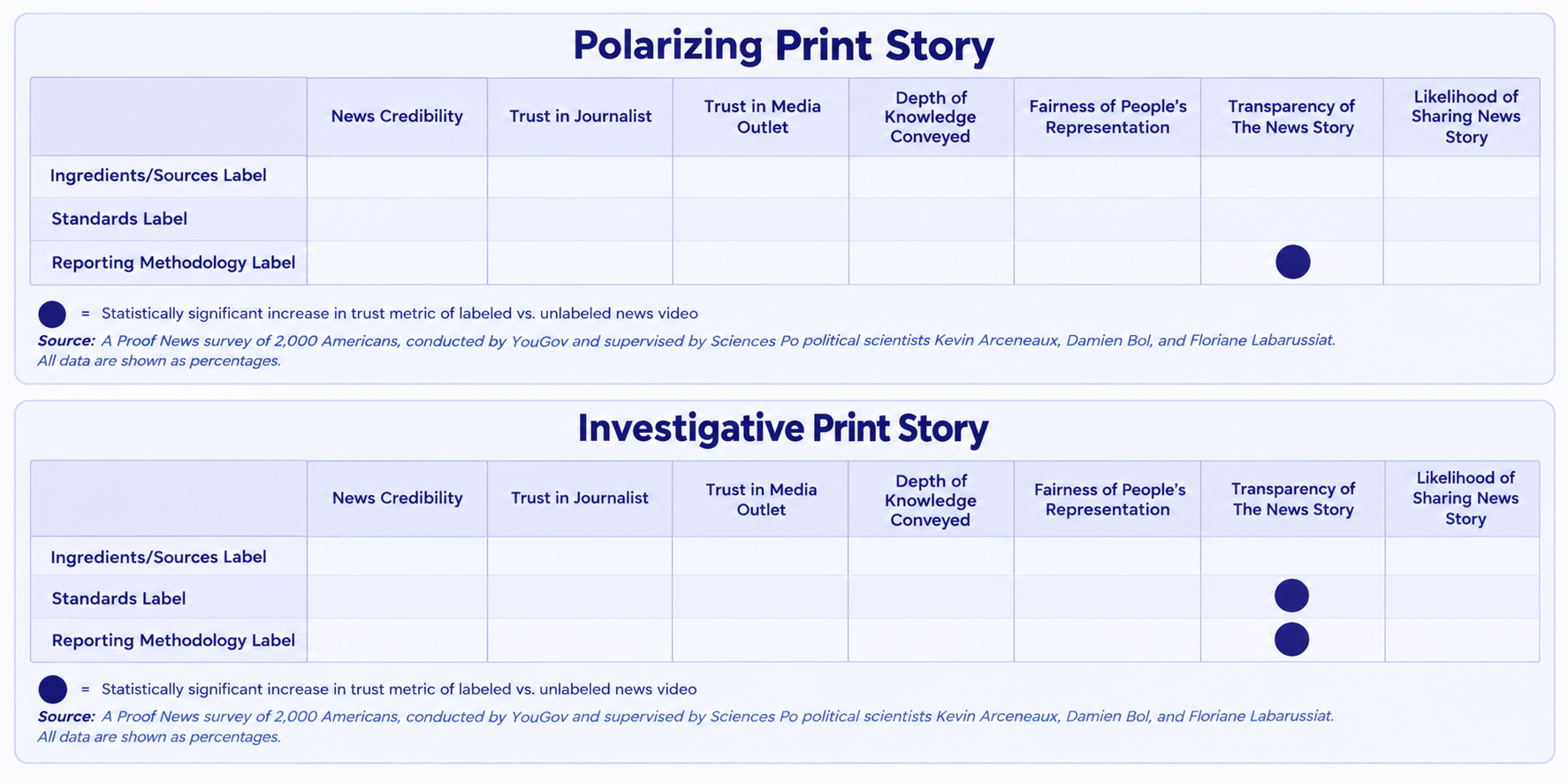
Two of the labels showed statistically significant findings. The Reporting Methods label improved transparency on the polarizing and investigative stories. That label and Standards label also showed improved transparency on the investigative story. Other differences in responses were too small to be statistically significant.
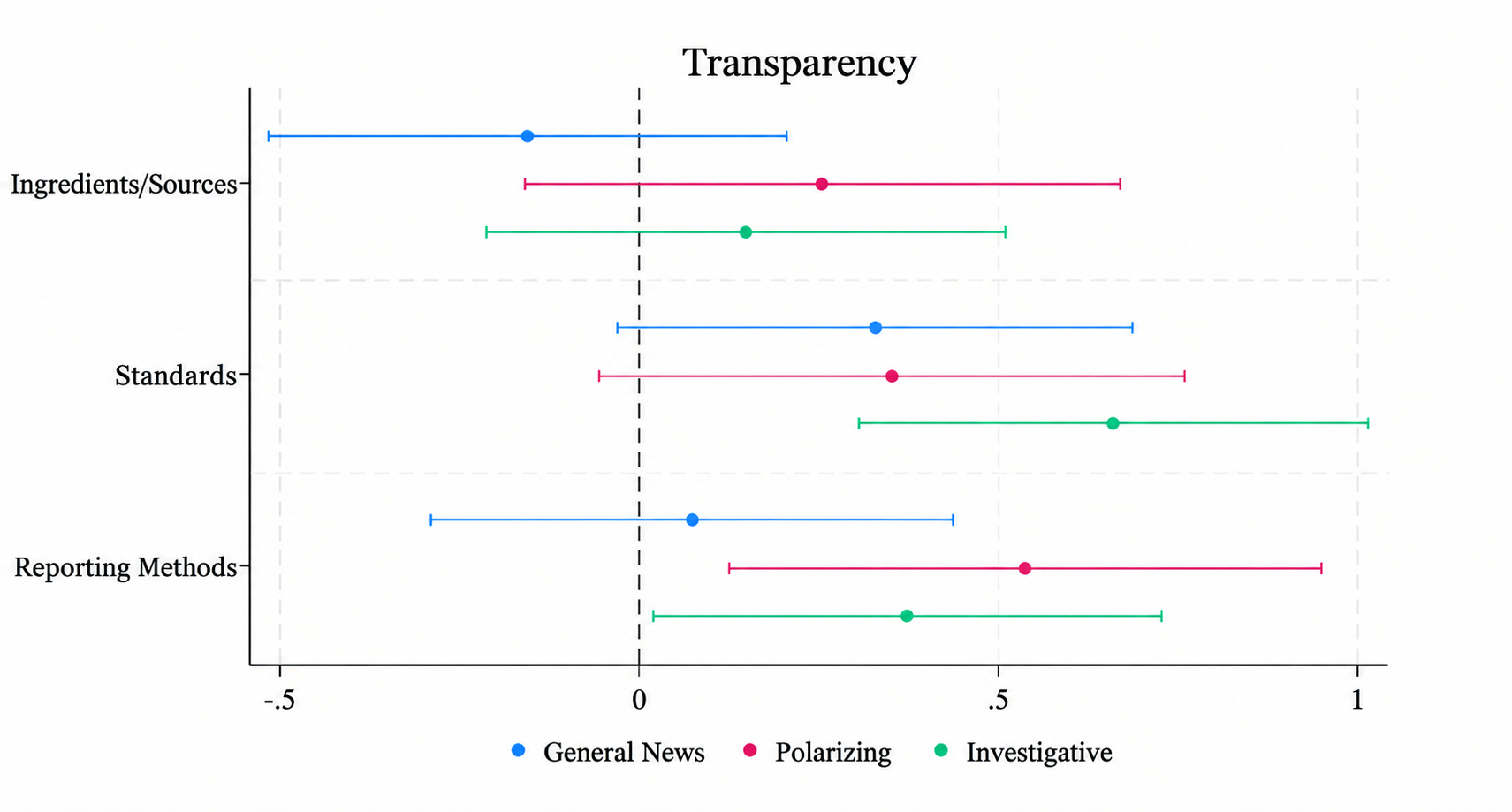
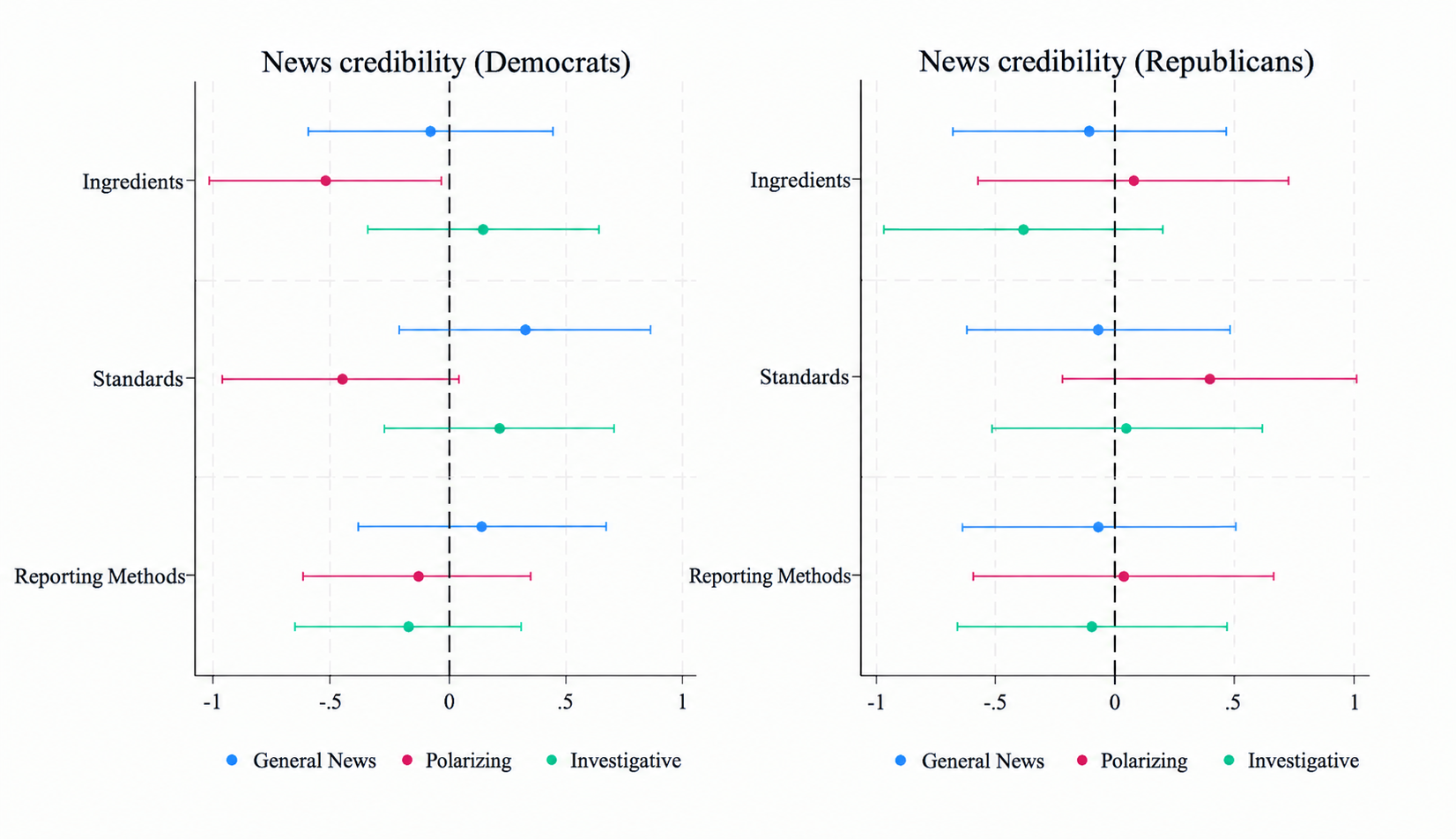
Some effects showed up only in subgroups. When drilling down into respondents' political affiliations, researchers saw a negative effect with the Sources label among Democrats viewing the polarizing story, which was about tech workers petitioning against increased immigration enforcement and violence. The label decreased perceived credibility of the news story, trust in the journalist, and trust in the media outlet compared with the control group. The Standards label paired with the polarizing story had a similar effect among Democrats, decreasing the propensity to share the news.
Video Findings
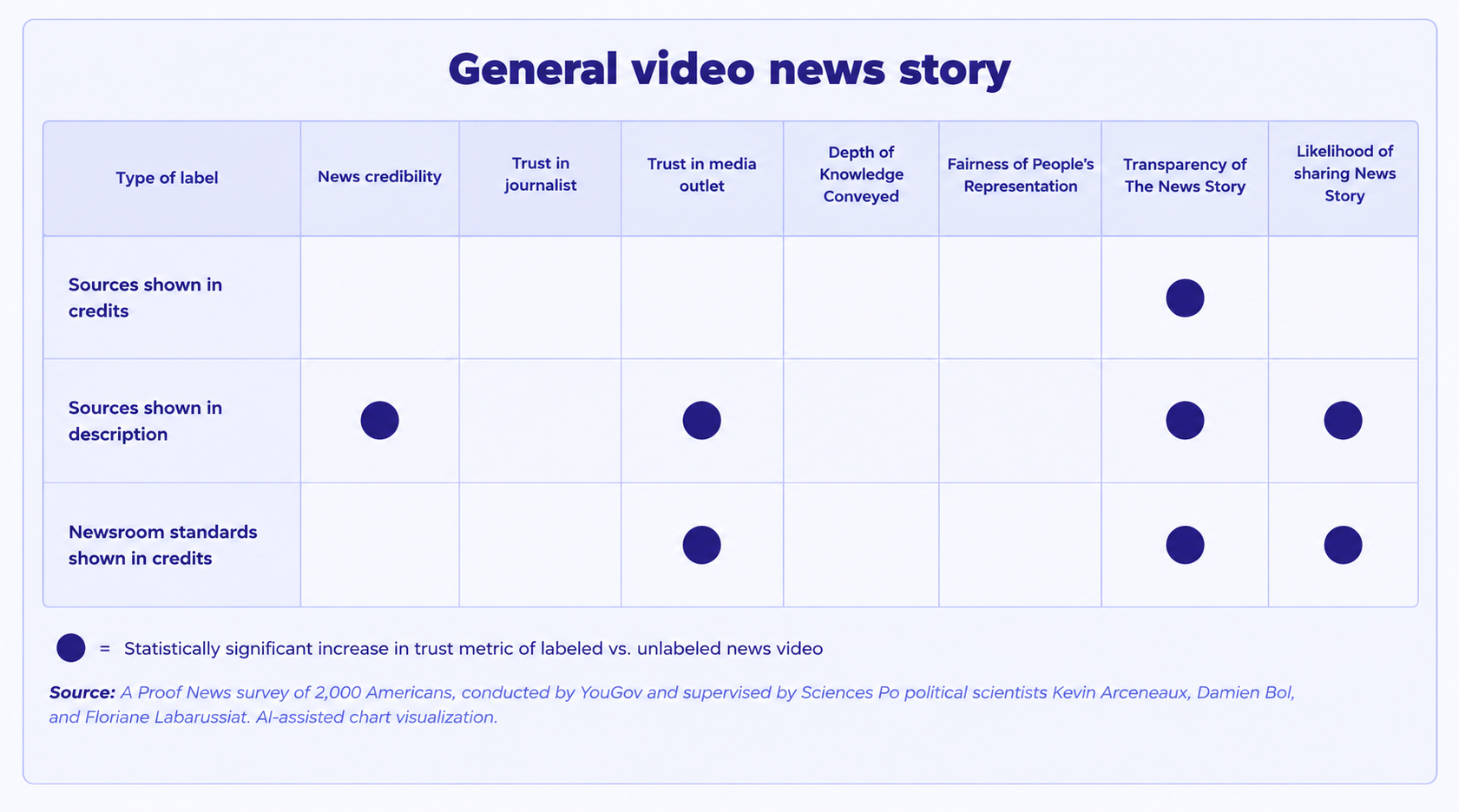
Overall, the effects of labels on video news were much more robust than for text stories, especially in the general news story type. When shown in the description, the Sources label elicited statistically significant increases in perceptions of trust in media, transparency, and likelihood of sharing.
The Standards label also triggered effects for the general news story on those same trust metrics.
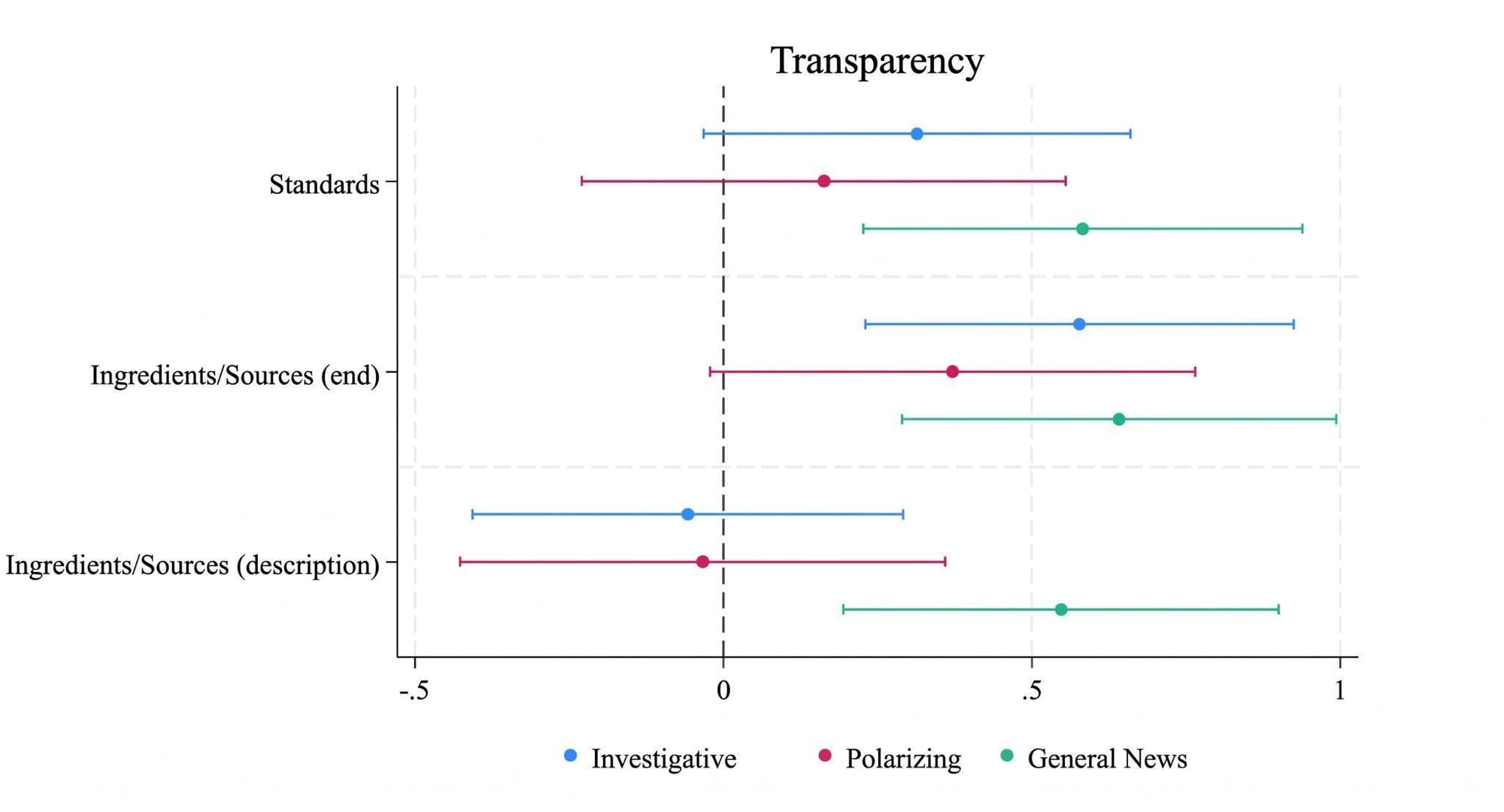
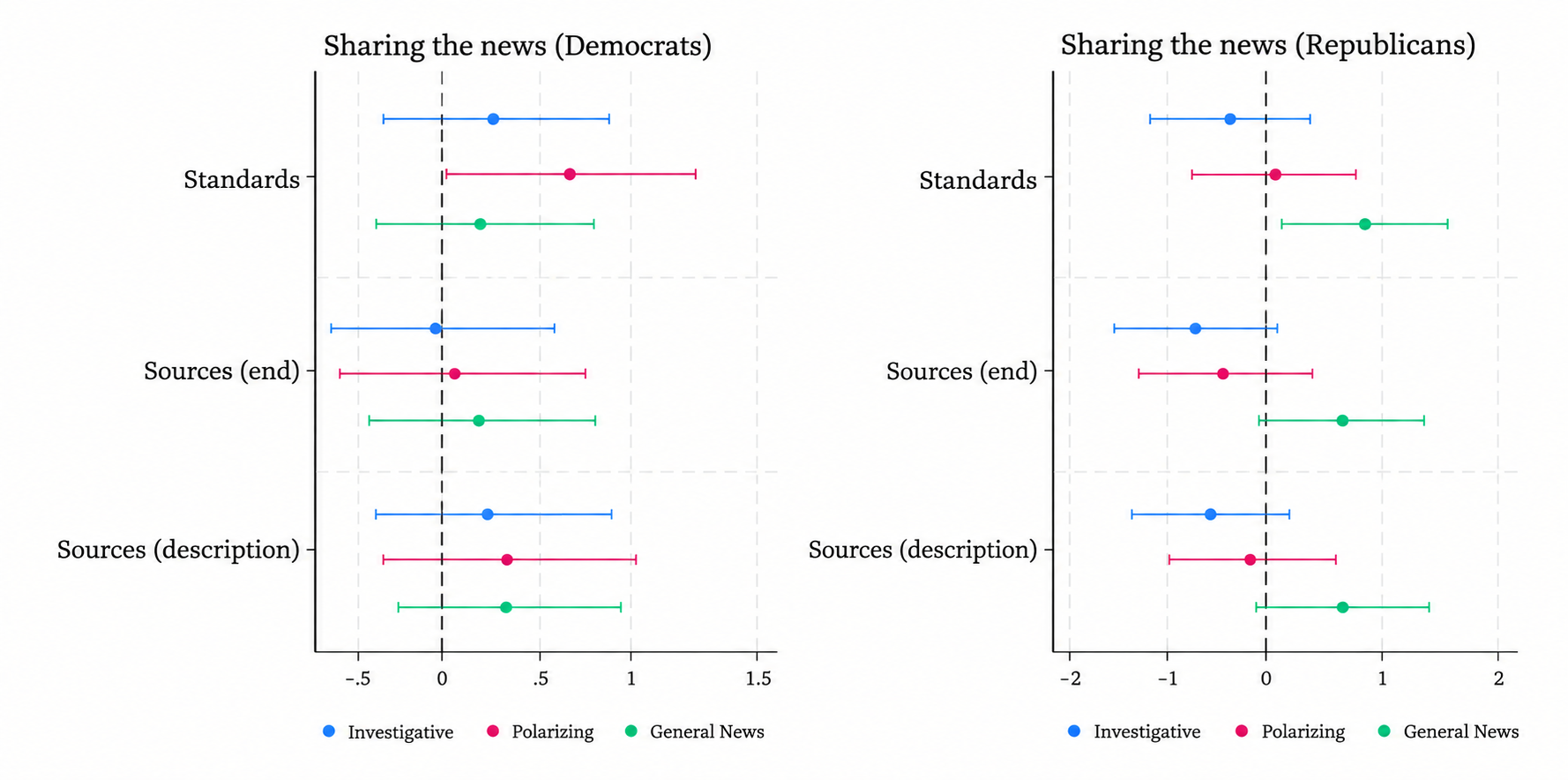
When researchers looked at subgroups, one important finding was that Republicans overall seemed less reactive to labels. All three types of labels increased the perceived credibility of the general news story among Democrats. This was not true for Republicans. For Democrats, any label seemed to increase their sense that the general news or polarizing article was transparent about how it was made.
Republicans reacted positively to one label: They were more likely to want to share the general news story when it was accompanied by the Standards label.
The subgroup that had a strong trust in science was more consistently receptive to labels than other groups. We categorized those who responded with a 5 or lower in the low-trust group, and all those who gave a higher than 5 in the high-trust group. Those who answered “Don’t know” were excluded.
When viewing the general news video about facial recognition in India, the group with a high trust in science rated the videos with the Sources label in the description as improving the news credibility, their trust in the journalist, the outlet, the depth of knowledge conveyed, and perceived transparency. Importantly, those in the low trust in science group were resistant to any label.
Conclusion
Labels work to improve viewer trust — especially with social video. The findings were more significant with video, perhaps because the videos we tested are short (about three minutes or less) and contain less information than text articles. Because of their brevity, the added information in labels may carry greater weight.
Another consideration is how different formats shape news consumers' experiences. When reading text, for example, people can quickly skim through it or skip parts of it, whereas a video forces them to follow the story second by second. The results seem to point toward a conditional effect of the label depending on the type of media and its format.
While wrapping up this research, Proof News participated in a convening of social media creators who produce stories about news, educational content, and science to discuss improving trust and transparency on video platforms. All participants expressed a strong interest in developing a shared set of standards and finding a way to help audiences distinguish high-quality, fact-based content from other media. We hope these findings show that another critical stakeholder values this strategy — the audience.
Ample opportunity remains for further investigation into how transparency labels affect audience trust, especially as AI-generated content rapidly alters the digital landscape. As synthetic content becomes ubiquitous, trust labels may become more vital.