This article was co-published with Harvard University's Nieman Lab.
About one in five US adults regularly gets their news from news creators on social media platforms, but it can be difficult for audiences to suss out which personalities to trust amid an avalanche of misinformation, hot takes, and polarizing content.
New research spearheaded by a team of journalists and political scientists shows that giving audiences a peek into the reporting process can help bolster their trust in the news.
Proof News, a nonprofit newsroom focused on tech accountability, in collaboration with researchers at the French university Sciences Po, shared social news videos with 2,000 US adults to measure their perceptions of trustworthiness. Participants were randomly assigned one of Proof’s yet-to-be-published short-form news videos.
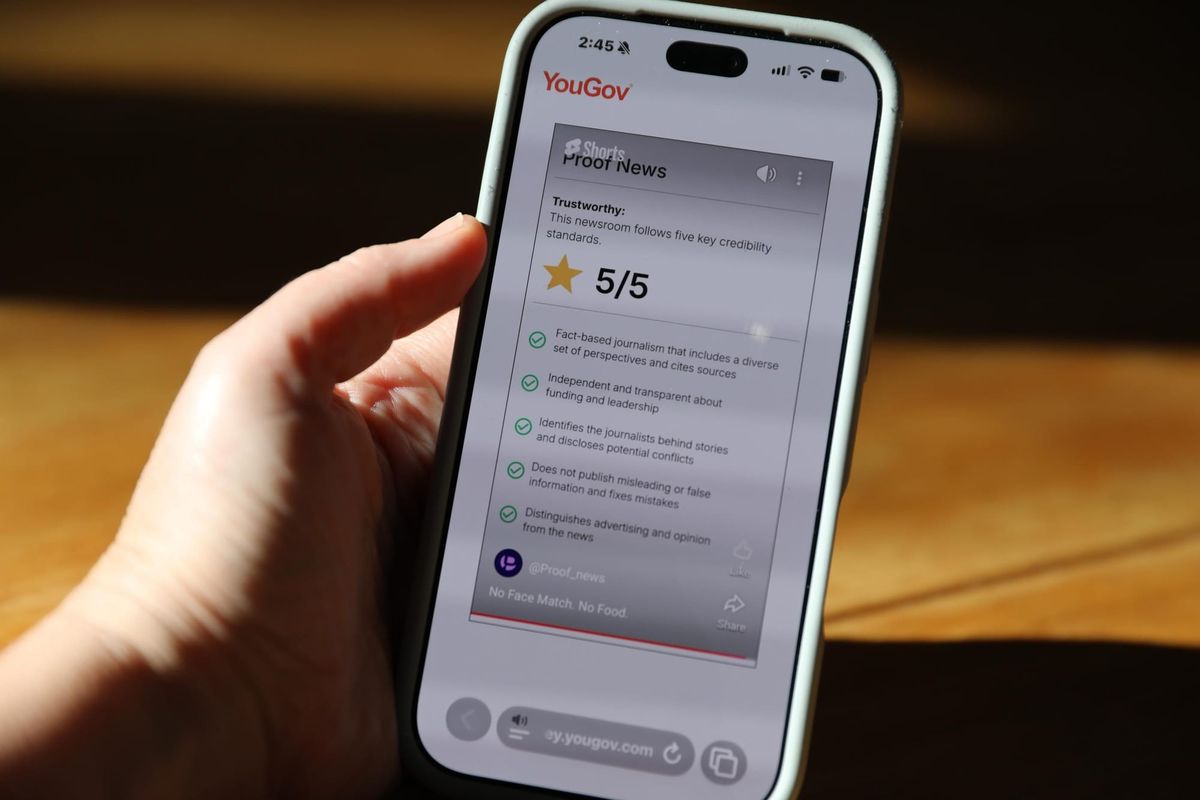
Some participants viewed videos with labels describing the sources, others saw videos with labels describing the newsroom’s ethical standards, and some saw videos without a label. The Sources label appeared on cards embedded at the end of the video, like a credits reel, or were placed into the video description, the text accompanying the video.
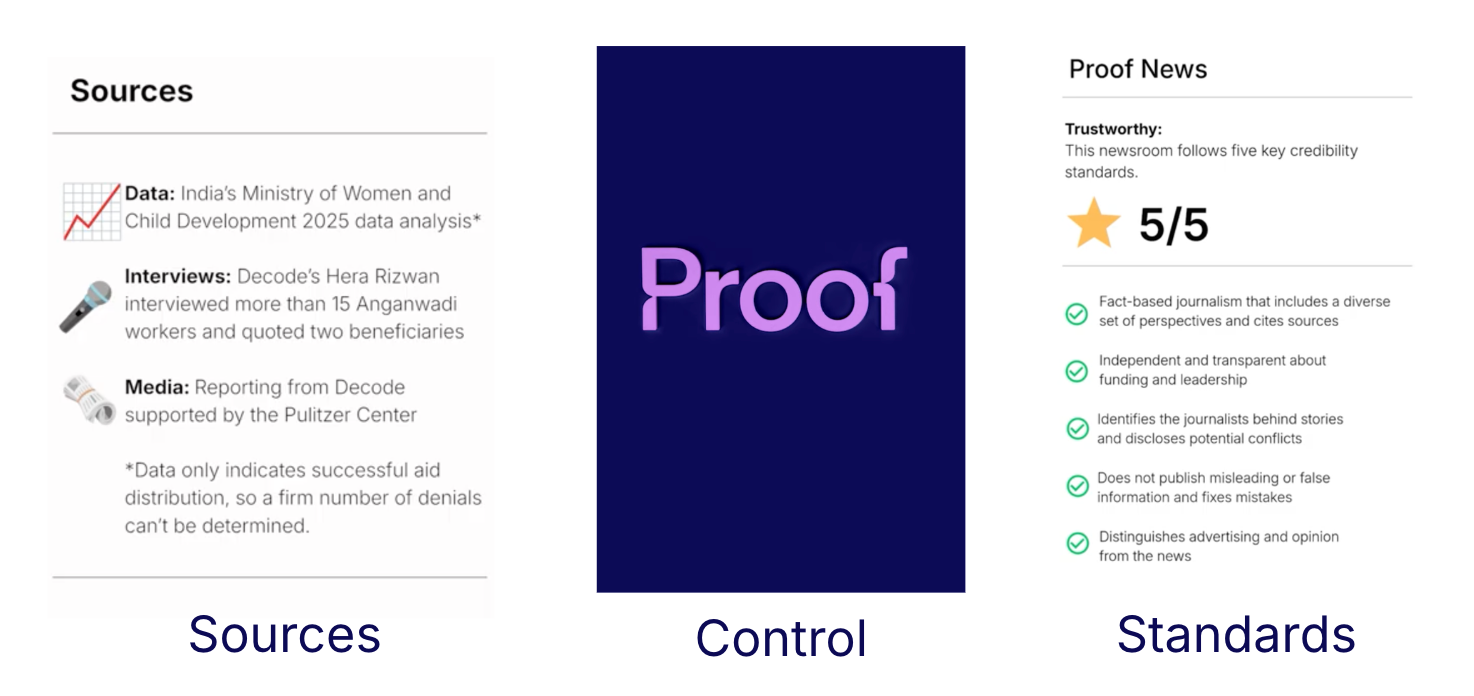
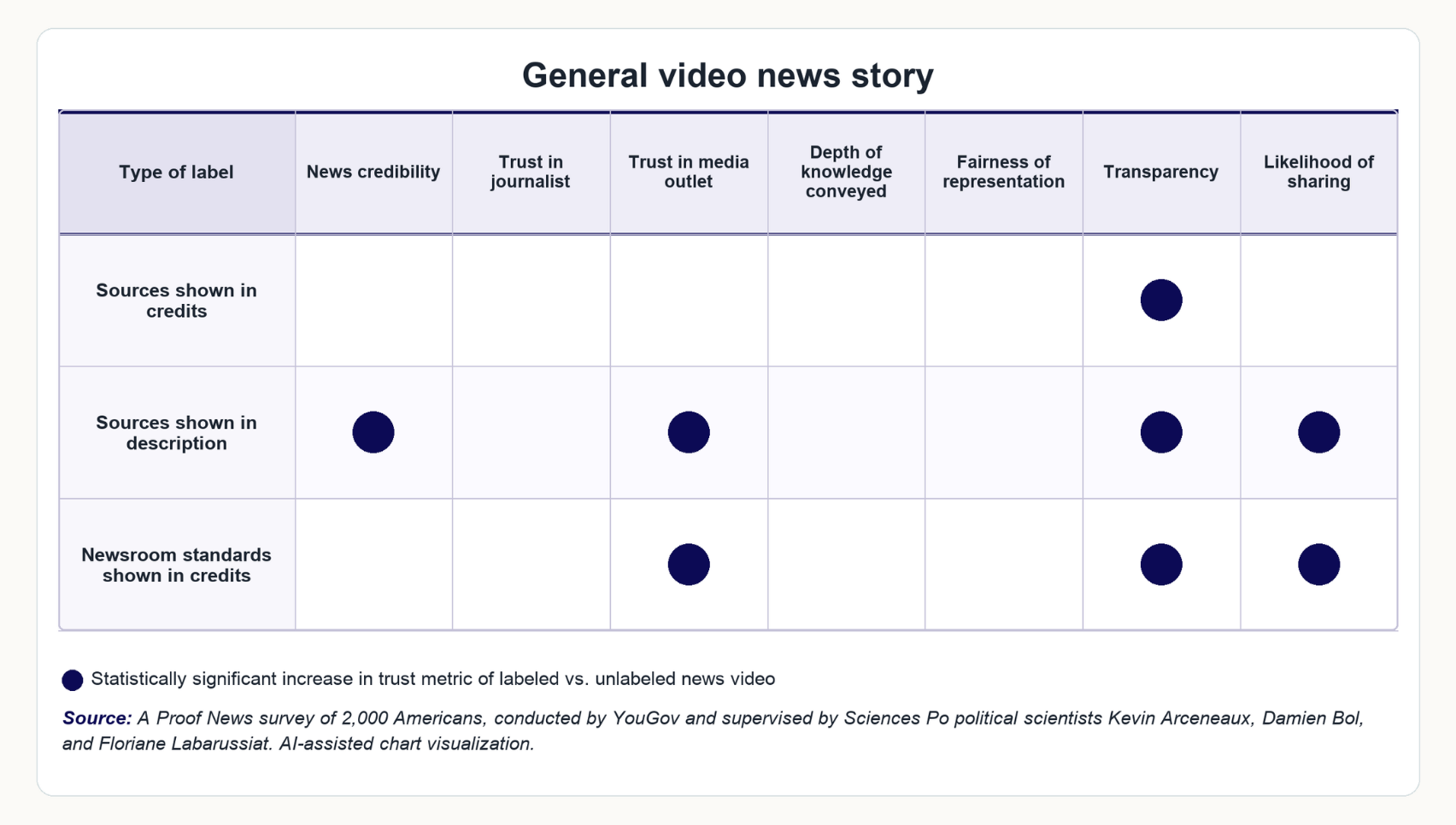
Participants then rated the videos on various trust metrics. We found that labeling videos did increase trust — particularly a label that described the video sources in the description and, to a slightly lesser extent, a label describing newsroom standards in the credits.
This effect was particularly prominent among survey respondents who identified as Democrats or reported having high trust in science. Those groups, when shown the sourcing label in the description of a general news video, reported higher assessments of transparency and trust in the journalist.
There were fewer statistically significant increases in trust metrics with labels for text articles, but Sally Lehrman, founder of the Trust Project, said the findings were still intriguing.
“I’m excited to see the results,” Lehrman said. “Methods and references really do resonate. . . People are asking, where did the journalist get this information, and how can I trust it.”
Lack of Standards
As audiences increasingly turn to social media for news, there is a growing public discussion about how trustworthy creators are, especially when it comes to disclosing their funding and relationships. In January, The Wall Street Journal wrote about corporate and foreign interests using influencers to push agendas. In August, The Washington Post reported that the Pentagon secretly hired conservative military veterans with large online audiences to amplify Defense Secretary Pete Hegseth’s messaging, and a New York Times investigation revealed online influencers received funding from political campaigns without disclosing the connection in their videos.
Some creators have begun trying to distinguish themselves from this type of behavior through their own disclosure efforts.
Journalist and creator Dave Jorgenson, who has nearly 1 million followers across TikTok, YouTube, and Instagram, has started publishing a transparency report on his website, Local News International, revealing his sources of funding alongside his editorial standards.
Ultimately, he thinks disclosures of political funding should no longer be voluntary but mandatory. “Platforms should be regulating themselves,” Jorgenson said in an interview. “You can't really force that unless there are laws.”
Proof used Jorgenson’s ethics and transparency statement as a model for the newsroom standards label in video testing and found that it increased viewers' trust in the news outlet and the likelihood that they would share a general news story.
New York City is already considering disclosure requirements in the wake of revelations in the Columbia Journalism Review that exposed the inner workings of New York City Mayor Zohran Mamdani’s connections with influencers. The author of the article, Anya Schiffrin, a senior lecturer at Columbia University's School of International and Public Affairs, testified at a September city council meeting that creator relationships — both paid and unpaid — should be disclosed to viewers.
“It's important for democracy that we have standards,” Schiffrin said.
Proof for a New Model
Proof News, which launched in 2024, pioneered an Ingredients label that takes cues from the scientific method and names the journalists’ hypothesis, sources, limitations, and the story’s findings.
To test whether the label worked to increase viewer trust for short-form vertical videos, we stripped down the Ingredients label to a bullet list of sources followed by an asterisk denoting the reporting limitations. The survey showed the label had a consistent positive effect when placed in the video description, the text box that is often located under the video.
The team also tested how labels performed on online text news articles. The survey showed 1,600 US participants original, unpublished Proof News stories without a label, with a Proof Ingredients label, a label modeled after the Trust Project that described the reporting process, and a label describing newsroom standards.
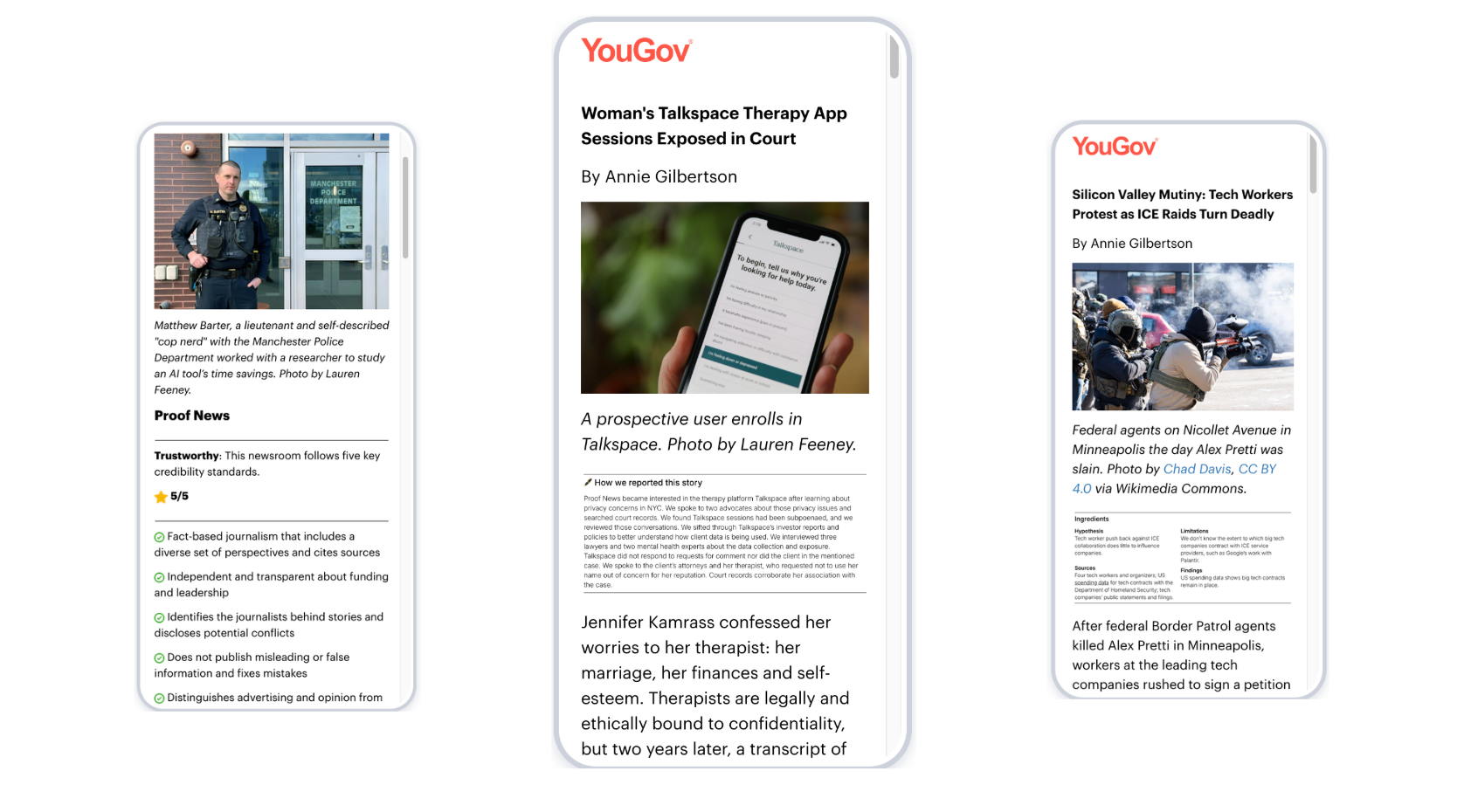
There were fewer statistically significant increases in trust metrics with the print labels. The most significant findings were an increase in perception of transparency when the reporting process label was used on a polarizing story and an investigative story.
One possible explanation for the differing results between labeling video and text articles is the “ergonomics” of the medium, said Damien Bol, a professor at the Center for Clinical Research at Sciences Po who helped lead the survey design and data analysis.
“When reading a text, for example, people can quickly skim through it or skip parts of it, whereas a video forces them to follow the story second by second, even when watching at double speed,” Bol said. Different formats, Bol said, shape the “experience of consuming a news story.”
Influencing the Influential
Earlier this month, Julia Angwin, an author of this article, hosted a private convening of creators at Harvard Kennedy School’s Shorenstein Center on Media, Politics and Public Policy to discuss creating shared standards that could be conveyed through a label or other public statement.
The group of 30 leading content creators from news, science communication, education, history, and other evidence-based fields discussed how they could distinguish their work by signaling to viewers their commitment to standards that could include disclosing funding sources and the use of artificial intelligence. Creator-led efforts to bring this to fruition are ongoing.
San Diego-based journalist Lisa Remillard, who has more than 4 million followers on TikTok channel “The News Girl,” said that making videos with verified facts can feel like a small club. But if she can’t independently confirm something, she’s “not putting that out there.”
Remillard’s audience appears to appreciate transparency. Earlier this year, she published a video describing her editorial standards — and was richly rewarded for it. “I think clearly defining those ethics and standards resonated with my audience and gave them a reason to want to financially support my work,” Remillard said.
Jessica Yellin, the founder of the political podcast, YouTube channel, and social media brand “News Not Noise,” has also called for news creators to voluntarily sign a Creator Constitution, agreeing to journalistic standards such as citing sources, fixing errors, and disclosing financial relationships.
She said labeling sources is about the “signal.” Even if audiences don’t take the time to digest every word, Yellin observed, “It's the act of showing it that matters.”
Julia Angwin is the founder of Proof News and the founding director of the Independent Media + Audience Project at the Shorenstein Center on Media, Politics and Public Policy at Harvard Kennedy School. Annie Gilbertson is managing editor of Proof News. Rina Palta is editor-at-large at Proof News and senior data scientist at the Independent Media + Audience Project.